
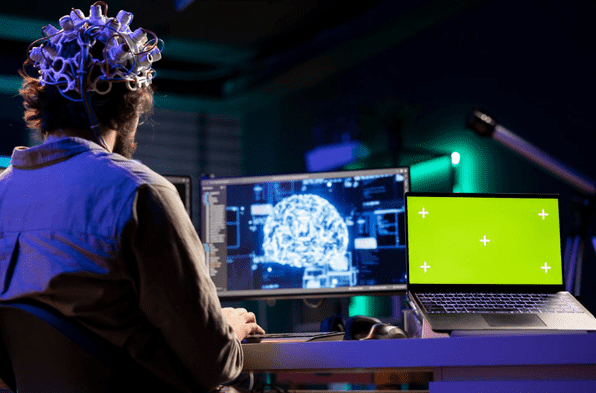
The United States continues to be the world hub of innovation, one major innovation that this decade holds is Brain‑Computer Interfaces (BCIs). These set-ups establish a direct communication path between the human brain and the external device, hence uniting the separate worlds that the user must interact with every day. In other words, these truly change how people interface with technology. In truth, they are changing how Americans look at healthcare solutions, immersive digital experiences, and assisted tools, and the United States plays a major role in their research and development.
Brain-Computer Interfaces are not a science anymore. They are a set of emerging practical tools meant to enhance cognitive functions in a special (and usually disabled) population. Therefore, this blog deals with what BCIs are, how they work, where they are used, and why they will represent the next revolution in U. S. technology.
What are Brain‑Computer Interfaces?
Brain‑Computer Interfaces (BCIs) allow the human brain and the machine communication directly. To be more precise, BCIs convert neural activities into commands to extend control over an external device. BCIs do not even make use of traditional input devices; what a person thinks holds the key.
Classically, BCIs are categorized into three types:
- Non-invasive types, using EEG caps
- Semi-invasive types, using electrodes inserted under the skull
- Invasive types, implanting directly under the scalp for high-precision mechanisms
Growth is especially rapid in BCI medical applications because BCI technologies have high investment levels and because U. S. universities and companies are pushing into healthcare applications, accessibility, and Internet communication rapidly compared to what other nations are doing.
How Brain‑Computer Interfaces Work
Despite their complexity, it is possible to break the different stages of the BCI process into these few very simple steps.
- For one thing, the electrodes pick up neural signals emanating from the brain. The non-invasive BCIs pick up brain wave activity from the surface of the scalp, while invasive BCIs record directly from neurons.
- Again, the system deals with these signals, suppressing the noise and creating conceptualized patterns called brain waves.
- In the following step, machine learning algorithms provide information on human intention and transmit related digital instructions.
- If there is a robotic arm, computer, or any form of assistive technology that reads this signal, it will be controlled by the commands produced.
The systems-based BCI is all about accurate, real-time brain-to-technology communication that creates some of the best ways in America for healthcare, in addition to transportation, productivity applications, and defense usage.
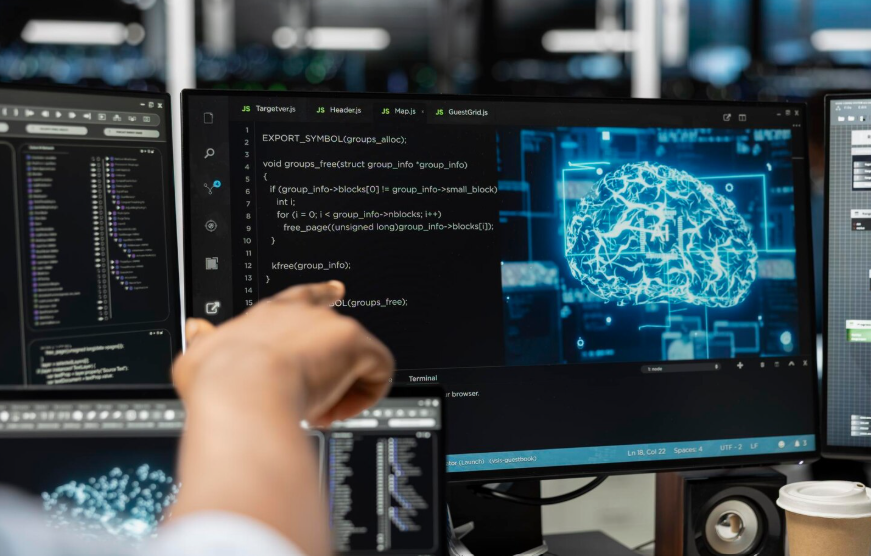
BCIs in the U. S.: Leading Applications
The United States leads the BCI establishment worldwide, almost solely due to government funding available, support for research, and tech-sector backing. The combined capability of BCIs to permeate multiple industries in the United States guarantees continued high growth.
Healthcare and Medical Rehabilitation
Brain-computer interfaces are modernizing healthcare in the U. S.; they allow for recuperation of mobility and communicative abilities in patients bearing on neurological disorders, spinal injuries, or ALS. For instance, in U. S. hospitals, Brain‑Computer Interfaces:
- Control robotic arms
- Allow the introverted to type with their thoughts
- Restore speech to those who cannot speak
- Aid in stroke recovery
As a whole, the uptake of Brain‑Computer Interfaces eventually delivers both independence and improved life quality for many in the United States.
Neuroprosthetics and Assistive Technologies
This is one of the emerging areas in the U.S.; moreover, the technologies are being heavily funded by the Department of Defense and medical research agencies to support both veteran and civilian patients with limb loss.
The principles applied by BCIs include:
- Natural limb and movement, precise articulation control for prosthetic limbs
- Enhanced prosthesis control times
- An increase in grip and strength, synchronization, and better precision
- Thus, BCIs provide life-changing solutions to reinvigorate confidence and functional abilities.
Human-Machine Interaction and Productivity
U.S. tech companies, too, are studying BCIs to enhance digital interactions; furthermore, thanks to the rise of hands-free control, this technology could literally reshape how Americans interact with everyday objects.
Potential uses are:
- Thought typing, Hands-free computer navigation, VR, and AR experiences for computer use
- Smart home controlling, harnessing the thought force, could revolutionize the tools of scientific endeavor in the United States.
Gaming and Entertainment
The entertainment and video game industries have taken up BCIs in like manner. BCIs take data directly from the human brain so that players can control characters or manipulate the virtual environment through imagination. Therefore, after VR, BCI-based gaming might be the next stage to step.
Research and Academic Innovations
American research universities are at the forefront of innovations in BCIs. BCIs are finding an Indian application in studying real-time cognition, behavior, and neurological conditions. That is why the academic laboratories in the United States of America are on a continuous move with this unique blend of neuroscience and AI.
Benefits of Brain‑Computer Interfaces
Among U.S. industries, Brain‑Computer Interfaces (BCIs) have a broadly beneficial impact; moreover, some of the most significant and useful consequences include:
- Access: Furthermore, BCIs have enabled persons with physical disabilities to communicate and interact with greater self-reliance and independence.
- Enhanced Recovery of Motor Function: As a result, patients recover motor functions more quickly and effectively.
- Hands-Free Productivity: BCIs enable fast digital commands on the basis of thoughts.
- Defense Innovation: Based on human-machine collaboration, BCIs can be profound for safer and improved human-machine coordination.
- AI Research Expansion: Comparative data of the brain assists in the furtherance of machine learning, this being a valuable resource for BCIs.
In this respect, therefore, the U.S. sees a BCI-driven future of innovation as being pertinent across multiple sectors.
Challenges of Brain‑Computer Interfaces
Despite their promise, BCIs are bombarded with substantial challenges.
- Cost: to come up with these highly complex and advanced BCIs is time-consuming and extremely financially demanding.
- Signal Interference: This is likely to be associated with inaccuracy in the non-invasive BCIs.
- Ethics: Of the greatest concern are issues surrounding ownership of neural data and rights to privacy.
- U. S.- Medical Device Laws stipulate a requirement for stringent testing.
- Long-Term Safety: Do implants have advantageous prospects with respect to longevity, or are they debatable?
Nonetheless, researchers and some organizations throughout the U. S. continue to respond to these challenges.
Why the U. S. Will Go To BCI’s Future
The United States will dominate BCI’s future owing to huge investments, top-quality research bodies, and the soaring appetite for technology. According to an already popular agreement, these are supposedly some of the futures of BCI over the next decade:
- Health
- Assistive Technology
- Defense
- Games
- Business productivity
- Everyday devices
Moreover, as Americans embrace inclusivity and innovation, BCIs will be the tools for how they work, communicate, and interface with the digital world.
Summative Evaluation
Brain-to-computer interfaces can revolutionize both the technological landscape and daily life in the U. S. They provide a direct link between the brain and the digital world, thereby enabling hands-free communication, advanced prosthetic limb implantation, as well as novel ways of interacting with machines. While cellular barriers remain, the funding in the U. S. and notable advances in scientific technology are all working toward building this technology for global acceptance.
Indisputably, it promises a game-changing redefinition of human potential while reconceiving healthcare, communication, and all human-technology interaction dynamics. The age of Brain-Computer Interfaces is upon us for those willing to accept it.